
Cakes & pastry
Shortbread Crescent Cookies: Seven Variations
These crescent cookies are rolled from thin wedges of short pastry, with a small filling at the wide end. Mix the dough only until combined, chill sticky butter-based dough, then roll it about 2–3 mm thick. Bake at 170°C (340°F), using roughly 15–20 minutes as a guide, and stop before the cookies become dark and hard.
8 min read

Choose one dough and keep its formula together
These are tender short-pastry cookies, not yeast-raised rolls. The crescent shape comes from rolling a triangular piece of dough around a small amount of filling. The range below includes sour cream, kefir, butter and margarine versions.
Choose one complete formula for the first batch. Mixing the fat quantity from one version with the flour from another makes the outcome harder to judge. Softer does not mean better: the dough should come together without prolonged kneading.
For the butter versions, use butter around 82.5% fat and let it soften without melting. Margarine is included only in its own formula below; low-fat spreads vary in water content and should not be treated as universal replacements.
1. Sour cream crescents with jam
This version has a sweet dough and a jam filling thickened with cornflour. Keep the filling inside the wide end of each triangle and fold the corners over it before rolling.
Sour cream and jam crescents
Approximately 12 portions; the number of cookies depends on their size
Ingredients
- 260 g plain flour
- 100 g butter, about 82.5% fat, softened
- 100 g sour cream
- 1 egg
- 15 g vanilla sugar
- 60 g sugar
- 5 g baking powder
- 200 g jam, for filling
- 20 g cornflour / cornstarch, for filling
Method
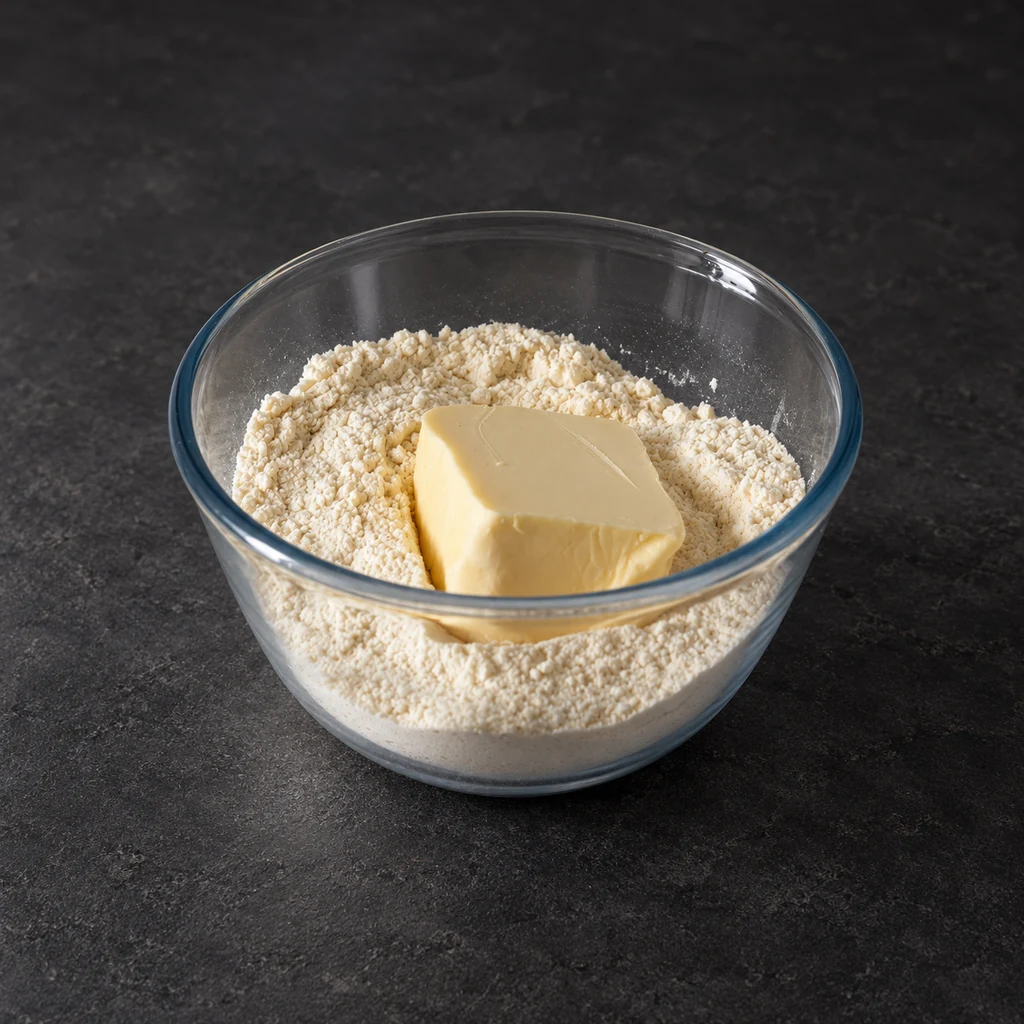
- Make crumbs. Mix flour, baking powder and both sugars. Rub in the softened butter with tools or cool hands until the mixture resembles even crumbs.
- Bring together and chill. Add the egg and sour cream. Mix into a soft, uniform dough without prolonged kneading. Wrap and refrigerate for about 1 hour.
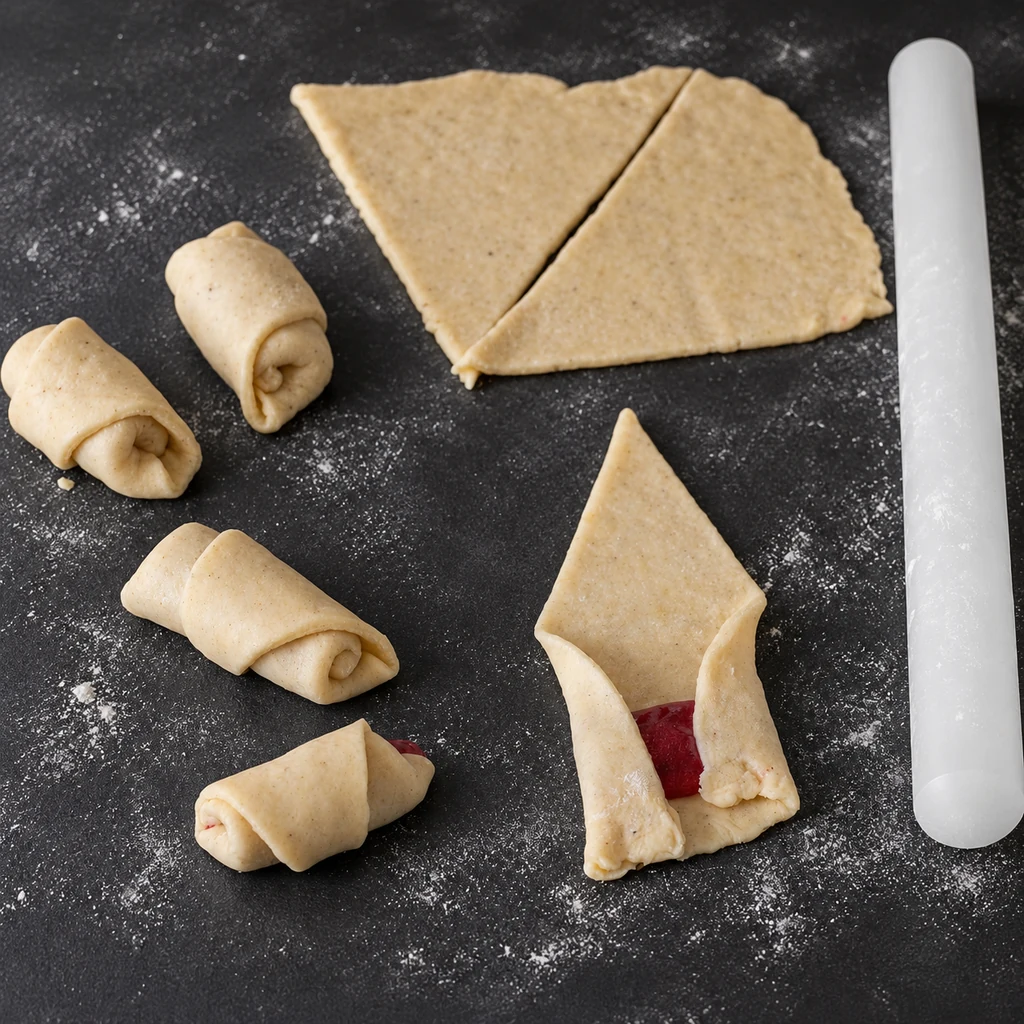
- Fill. Mix the jam with the cornflour. Divide the dough into 2–3 pieces, roll each into a 2–3 mm-thick circle and cut into narrow wedges. Put a little filling at each wide end, fold the corners inward and roll towards the point.
- Bake. Place on a lined tray and bake at 170°C (340°F) until set and lightly coloured, using 15–20 minutes as an initial guide.
2. Unsweetened dough with thick fruit preserve
The sweetness in this variation comes from a thick fruit preserve and the sugar coating. The dough itself contains no added sugar. Choose a dense preserve rather than a runny fruit sauce.
Thick-preserve crescents
Approximately 12 portions; the number of cookies depends on their size
Ingredients
- 200 g plain flour
- 125 g butter, softened
- 50 g sour cream
- 1 egg
- 200 g thick fruit preserve
- as needed sugar, for coating
Method
- Mix the dough. Rub the flour with the softened butter. Add sour cream and egg, then mix only until uniform. Wrap and chill for about 1 hour.
- Roll and fill. Roll about 2–3 mm thick, cut into long wedges and put a small amount of preserve at the wide end. Roll towards the point.
- Coat and bake. Roll the shaped cookies lightly in sugar. Bake on a lined tray at 170°C (340°F) until set and lightly golden; begin checking around 15 minutes.
Even a thick preserve can escape if the cookie is overfilled.
3. Kefir and oil crescents
This dough uses vegetable oil instead of butter. The filling can be a nut, a small piece of chocolate or another suitable bake-stable filling. Choose small pieces that fit inside the wedges without tearing the dough.
Kefir crescents
Approximately 12 portions; the number of cookies depends on their size
Ingredients
- 350 g plain flour
- 120 g neutral vegetable oil
- 150 g kefir
- 1 egg
- 15 g vanilla sugar
- 10 g baking powder
- 50 g sugar
- as needed suitable filling, such as nuts or chocolate
Method
- Combine. Mix the flour with the egg, oil and both sugars. Stir the baking powder into the kefir, then add it to the other ingredients.
- Make and divide the dough. Mix into a soft, uniform dough. Divide into 2–3 pieces and roll each into a thin circle.
- Shape. Cut into narrow wedges, place a small filling at the wide end and roll towards the point. A light dusting of extra sugar on the rolled dough is optional.
- Bake. Arrange on a lined tray and bake at 170°C (340°F), checking from around 15 minutes until set and lightly coloured.
Do not replace 10 g baking powder with 10 g baking soda; that is not an equivalent substitution.
4. Margarine jam pockets
This variation is shaped as folded half-moons rather than rolled triangles. Cornflour is used both in the dough and in the jam filling, so measure those quantities separately.
Margarine and jam half-moons
Approximately 12 portions; the number of cookies depends on their size
Ingredients
- 150 g baking margarine, softened
- 100 g sour cream
- 250 g plain flour
- 30 g sugar
- 50 g cornflour / cornstarch, for the dough
- 200 g jam
- 20 g cornflour / cornstarch, for the filling
Method
- Make crumbs. Mix flour, sugar and the 50 g dough cornflour. Rub in the softened margarine, then add the sour cream and mix just until combined.
- Chill if needed. If sticky, wrap and refrigerate for 30–40 minutes. Use only enough dusting flour to roll it without sticking.
- Fill. Mix jam with the 20 g filling cornflour. Roll the dough a few millimetres thick and cut circles. Put a little jam on one half, fold over and seal the edge.
- Bake. Bake on a lined tray at 170°C (340°F) until set and lightly golden, with 15–20 minutes as a guide. Let the fragile cookies settle before lifting.
5. Nut-filled crescents
An egg-white-and-nut filling keeps the chopped nuts together inside the cookie. Use the yolk in the dough and the white in the filling; there is no need to add an extra whole egg.
Nut-filled crescents
Approximately 12 portions; the number of cookies depends on their size
Ingredients
- 250 g plain flour
- 100 g butter, about 82.5% fat, softened
- 100 g sour cream
- 1 egg yolk, for dough
- 5 g baking powder
- 100 g nuts, chopped
- 50 g sugar, for filling
- 1 egg white, for filling
Method
- Make the dough. Mix flour and baking powder, rub in the butter, then add yolk and sour cream. Combine briefly, wrap and chill for about 1 hour.
- Make the filling. Chop the nuts into small pieces rather than a fine paste. Mix with the egg white and 50 g sugar.
- Shape. Roll dough 1–2 mm thick, cut into long triangles and distribute filling at the wide ends. Roll into narrow crescents without forcing filling out.
- Bake. Bake on a lined tray at 170°C (340°F) until the dough and egg-white filling are cooked and lightly coloured, using 15–20 minutes as a starting guide.
Put all 50 g sugar into the nut filling.
6. Crescents with bake-stable fruit jelly
Use a fruit paste or jelly specifically suitable for baking. A product containing pectin is not automatically oven-stable, and a soft table jelly may melt and run out.
Fruit-jelly crescents
Approximately 12 portions; the number of cookies depends on their size
Ingredients
- 240 g plain flour
- 100 g butter, about 82.5% fat, softened
- 100 g sour cream
- 1 egg yolk
- 5 g baking powder
- 15 g vanilla sugar
- as needed bake-stable fruit jelly or fruit paste
Method
- Make the dough. Mix flour, baking powder and vanilla sugar. Rub in the butter, then add yolk and sour cream. Mix until uniform; wrap and chill for about 1 hour if sticky.
- Roll and fill. Divide into manageable pieces and roll into thin circles. Cut into triangles and place a small piece of bake-stable fruit filling at each wide end.
- Bake. Roll into crescents and bake on a lined tray at 170°C (340°F) until set and lightly coloured. Begin checking around 15 minutes.
7. Sugar-coated almond crescents
These need no filling. A little almond flour adds flavour to the dough, while the measured sugar is used on the rolling surface.
Sugar-coated crescents
Approximately 12 portions; the number of cookies depends on their size
Ingredients
- 140 g butter, about 82.5% fat, softened
- 50 g sour cream
- 250 g plain flour
- 1 egg
- 25 g almond flour
- 100 g sugar, for rolling
Method
- Mix. Combine plain and almond flour. Rub in the butter, then add sour cream and egg. Mix briefly into a uniform dough.
- Roll with sugar. Divide the dough into 3 pieces. Sprinkle some of the measured sugar on the rolling surface and roll each piece into a thin circle, using the remaining sugar for subsequent pieces.
- Shape and bake. Cut into triangles and roll towards the points. Bake on a lined tray at 170°C (340°F) until set and lightly golden, using 15–20 minutes as a guide.
Bake lightly and let the cookies firm as they cool
Preheat the oven before the shaped cookies go in. Keep their sizes similar within each tray so that the smallest do not become hard while the largest are still underdone.
Short pastry firms as it cools. Do not wait for every cookie to become dark brown and rigid in the oven. Look for a cooked, set structure with light colour, and adjust the time for your actual size.
Let the cookies settle before moving them, especially the thin half-moons. Once completely cool, add a little icing sugar if desired. Store different fillings with their own ingredient requirements in mind rather than applying one shelf-life claim to all seven versions.
Keep the raising agent matched to the selected dough.
Make a separate nut-and-caramel component for other pastry projects.
Distinguish a soft cake filling from a filling intended to bake inside a cookie.
Common questions
Are these yeast rolls?
No. These are short-pastry cookies shaped into crescents or half-moons. Their tender, crumbly texture is different from a bread roll.
Can I use runny jam?
A runny filling is more likely to escape. Use the thickening instructions in the selected recipe or a suitable bake-stable preserve, and avoid overfilling.
Why did the cookies turn hard?
Check for excessive kneading, too much dusting flour or overbaking. Short pastry becomes firmer as it cools, so deep browning is not the target.
Can I swap all the butter for a low-fat spread?
Not automatically. Water and fat content vary. Use the complete margarine formula if that is your chosen ingredient rather than treating every spread as equivalent.
How many cookies will I get?
It depends on the circle size and wedge width. The formulas are given as about 12 portions, not a guaranteed count of identical cookies.