
Macarons
How to Pipe Even Macarons: Position, Pressure and Spacing
Use a flat tray, a round piping tip and a size guide beneath a suitable mat. Hold the bag upright, keep the tip centred, squeeze steadily and stop pressure before lifting away. Pipe a few test rounds first: if they spread uncontrollably or keep tall peaks, check the batter before filling the tray.
4 min read
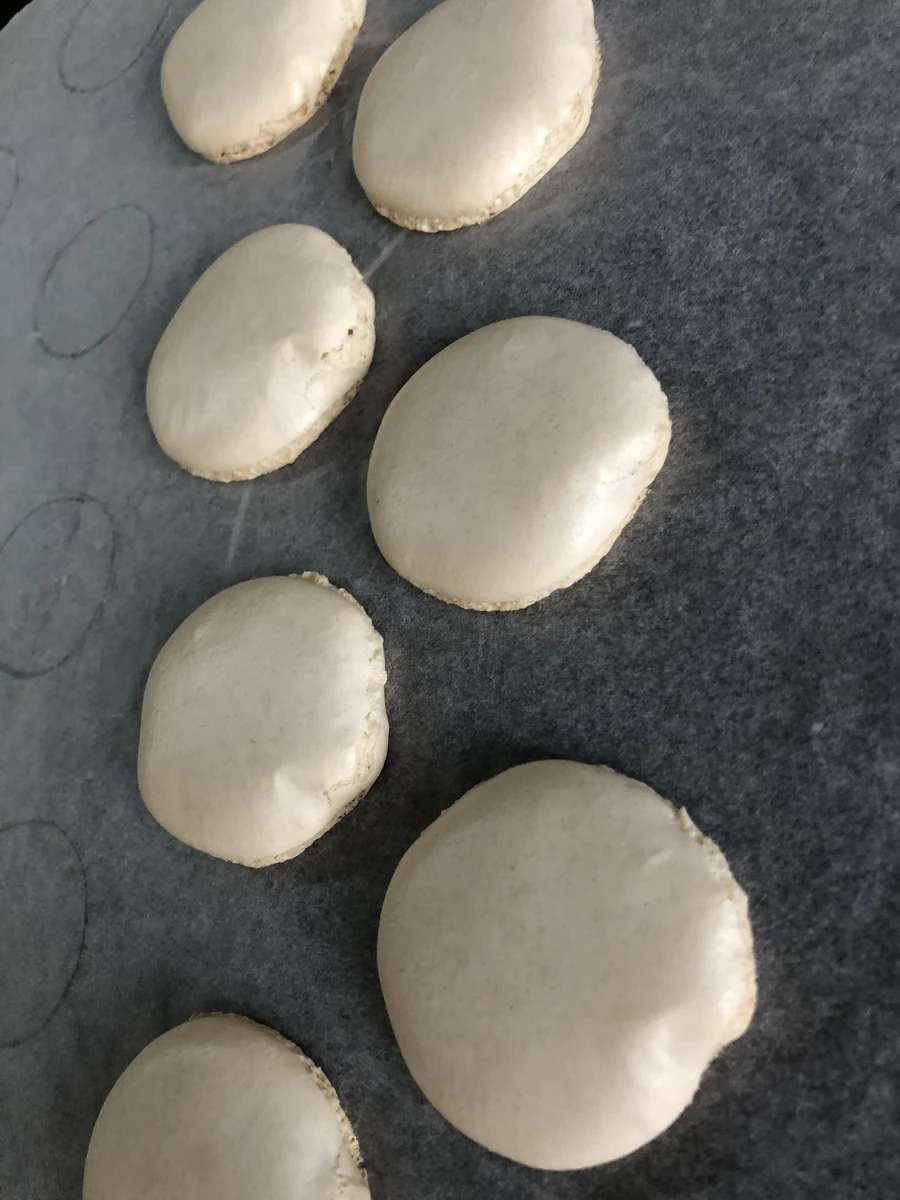
Set up the tray before filling the bag
Choose a flat tray and a clean, dry baking surface. The mat or paper should lie flat without ripples. A printed guide is useful for repeating size, but it must not distort the surface above it. Use staggered rows with room around every round instead of squeezing a few extra macarons into the remaining gaps.
If a printed sheet sits beneath a translucent mat or paper, remove the sheet before baking. Check its printed dimensions with a ruler: printer scaling can change the size. Treat the guide as the target area for the piped batter, not a promise that every finished shell will match that diameter exactly.
Give your hands separate jobs
Fit a round tip and fill the bag without overloading it. Twist the top so pressure comes from above the batter rather than from squeezing the middle of an open bag. Your upper hand controls flow; your lower hand guides the tip. Keep your grip comfortable enough to repeat the motion across the tray.
Hold the bag upright over the centre of the first guide. Keep the tip close enough for the batter to build from the centre instead of falling in a wandering strand, while leaving room for the round to grow. Avoid burying the tip in the batter or dragging it sideways to spread the circle.
Repeat squeeze, stop and lift
Squeeze steadily while holding the tip in one place. As the round approaches your target size, stop pressure first, then lift away with a small controlled motion. Continuing to squeeze as you lift creates a trailing strand. Sweeping a large circle with the bag can distort the edge.
Pipe a short row and pause. Look at the rounds as they settle: are they similar in size, and do the tails relax? If one is larger, adjust the duration or pressure of the next squeeze. Do not chase every small difference by adding tiny extra deposits to rounds that have already settled.
- Centre the tip before applying pressure.
- Keep the bag upright while the round grows.
- Release pressure before moving away.
- Compare a few rounds before continuing.
Separate piping faults from batter faults
A consistent hand motion cannot repair an unsuitable batter. If every round spreads far beyond the guide, stop and assess the mixture. If prominent peaks remain on every round, compare the batter flow with your recipe before assuming that your lifting motion is the only cause.
| What happens | Check first | Avoid |
|---|---|---|
| Rounds become ovals immediately | Upright bag, centred tip, flat surface | Dragging batter sideways into a circle |
| An occasional round comes out unevenly | A blocked tip or uneven pressure | Forcing a particle through with extra pressure |
| Every round spreads excessively | Batter consistency and folding endpoint | Piping smaller and hoping the structure returns |
| Tall peaks remain throughout the tray | Batter flow and pressure release | Smoothing every peak with a wet finger |
| Sizes vary but rounds stay round | Repeatability of pressure and target size | Changing the recipe to solve hand control |
Keep the layout consistent to the last row
Allow the same space around the final rounds as around the first. An overcrowded corner is difficult to compare with an open centre and can bake differently. If there is batter left, use another prepared tray rather than filling every gap. Record any waiting-time difference between trays when you evaluate them.
If your method includes tapping the tray, use controlled taps to settle it and bring larger bubbles towards the surface. Inspect the outlines afterwards. Aggressive handling can undo careful piping, and tapping cannot turn overmixed batter back into a stable foam.
See why the pattern and spacing of the whole tray matter.
Check the batter if good piping technique still gives poor rounds.
Practise for consistency before changing size
Use one target size for a batch and match pairs after cooling. Photograph the freshly piped rounds and the baked tray from the same angle. If the sizes were even before baking but not afterwards, investigate the bake; if they differed from the start, keep practising the squeeze and release.
When you deliberately change diameter, plan a new baking trial. Larger and smaller shells do not necessarily finish together. Keep a note of the guide size, the approximate filled size and the result, so your next tray starts from a useful reference instead of a guess.
Common questions
Do I need a printed template?
A guide helps with repeating size, but a marked mat can do the same job. Check any printed scale and remove non-baking paper guides before the tray goes into the oven.
Can I pipe macarons without a metal tip?
A round tip makes the opening more consistent. A cut bag can distort or open unevenly, which adds another variable while you are learning. Choose a tip appropriate to your shell size and method.