
Mousse & pastry
Gelatin Bloom Conversion: Weight, Powder and Sheets
Start with the dry gelatin weight and the Bloom strength of both products. A practical linear conversion is new dry weight = recipe dry weight × recipe Bloom ÷ your Bloom. Treat it as a starting estimate, not a guarantee of identical texture. Hydrated gelatin mass and sheets need an extra check because water and sheet weights can differ.
6 min read
What the Bloom number tells you
Bloom is a standard measure of gelatin gel strength. A higher number indicates a firmer standard test gel at the same concentration. It does not tell you the exact texture of every mousse, fruit insert or glaze made with that product.
The final dessert also depends on gelatin concentration, acidity, sugar, other ingredients, chilling time and temperature. Two products with the same Bloom can still behave differently in a specific formulation. Keep the gelatin type and product information with your recipe notes.
For a recipe you want to repeat closely, the easiest starting point is the same gelatin specification used by the recipe. Conversion becomes useful when that product is unavailable, but a small trial remains the practical check.
Find the actual strength and dry weight
Look for a Bloom value on the pack or the manufacturer’s current product specification. Do not assume that every packet from a brand has the same strength in every country. A sheet colour or metal name such as gold is a product grade, not a substitute for checking the exact pack.
If the recipe only says gelatin without a strength, ask for the intended product or use a known recipe with a clear specification. Automatically assuming 200 Bloom hides an unknown rather than resolving it.
For sheets, record both the dry weight and the specified strength. Some product ranges adjust sheet weight to give similar setting power per sheet, but sheet-for-sheet substitution is not universal across manufacturers.
The practical linear conversion
Use the original dry gelatin weight, multiply by the original Bloom, then divide by the Bloom of the gelatin you have. Stronger gelatin gives a smaller estimated weight; weaker gelatin gives a larger one.
Example: a recipe uses 20 g of 180 Bloom gelatin and you have 220 Bloom. The estimate is 20 × 180 ÷ 220 = 16.36 g. With a suitable scale, weigh about 16.4 g for the trial rather than repeatedly rounding the intermediate factor.
This linear rule is a practical pastry approximation. It does not predict identical gel firmness across every concentration, gelatin source or recipe. Follow a supplier’s product-specific equivalence when available, and test the finished dessert after its full setting and serving cycle.
| Gelatin available | Linear factor | Estimated dry amount |
|---|---|---|
| 160 Bloom | 1.25 | 12.5 g |
| 180 Bloom | 1.111 | 11.1 g |
| 200 Bloom | 1.00 | 10.0 g |
| 220 Bloom | 0.909 | 9.1 g |
| 240 Bloom | 0.833 | 8.3 g |
| 250 Bloom | 0.80 | 8.0 g |
Powder and sheets: compare dry gelatin first
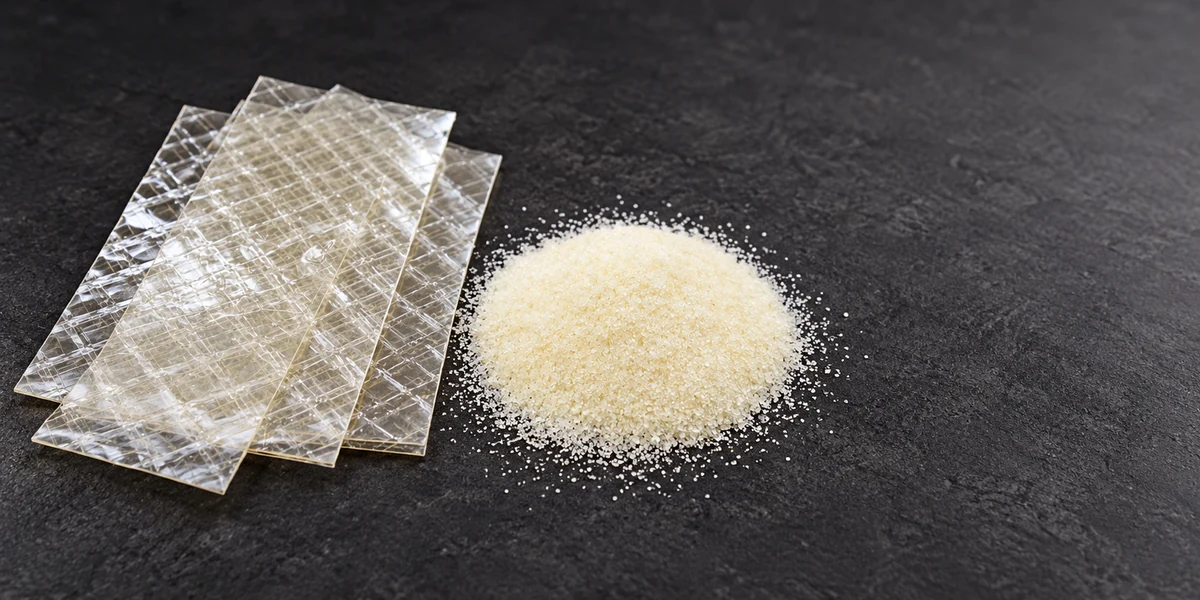
If powder and sheets have the same specified Bloom, comparing equal dry weights is a practical starting point. Do not compare 10 g of dry powder with 10 g of already soaked sheets: part of that soaked weight is water.
Hydrate each product according to its instructions. Powder is commonly hydrated in a measured amount of cold water. Sheets are often soaked in excess cold water and squeezed before dissolving. The retained water is not automatically identical to a measured powder hydration ratio.
For a tightly balanced recipe, keep track of hydration water in the total liquid. Changing from squeezed sheets to powder plus a large measured water addition can change the texture even when the dry gelatin conversion is correct.
Convert gelatin mass back to dry gelatin
Gelatin mass is gelatin that has already been hydrated with a known amount of water. The ratio must be specified. A 1:6 gelatin-to-water mass contains one part dry gelatin and six parts water, so seven parts total. A 1:5 mass contains six parts total.
Dry gelatin = mass weight ÷ (1 + water ratio). For a 1:6 mass, 70 g contains 10 g dry gelatin and 60 g water. For a 1:5 mass, the same 70 g contains about 11.7 g dry gelatin. Those are not interchangeable amounts.
If a recipe calls for 50 g of a 1:6 mass made with 160 Bloom gelatin, the dry amount is 50 ÷ 7 = 7.14 g. Converting that to 140 Bloom by the linear method gives 7.14 × 160 ÷ 140 = 8.16 g dry gelatin. Then plan its hydration water explicitly rather than adding 50 g of dry powder.
When converting a stored gelatin mass, change both the dry amount and the water bookkeeping deliberately. Keep the dessert’s intended total liquid in view and test the result. A calculation of dry weight alone does not settle every hydration difference.
Make the trial answer the real question
Use a small but accurately weighed batch with the intended fruit, dairy, sugar and acidity. Allow the full setting time and test it at the serving temperature. A mousse that seems firm straight from the refrigerator may soften differently on the plate.
If the dessert will be frozen and thawed, include that cycle in the trial. Assess the cut, mouthfeel and any liquid release. A plain water gel is useful for comparison, but it cannot reproduce every behaviour of a rich dessert.
Record the gelatin brand, product, Bloom, dry weight, hydration ratio and finished texture. Once the result suits the dessert, keep that exact combination as the working recipe.
What this calculation cannot replace
Agar and pectin are different gelling agents. A Bloom conversion does not turn gelatin grams into an equivalent agar or pectin amount. Their processing and textures differ.
Likewise, more gelatin does not repair a batch in which it was never fully hydrated or dissolved. Identify the process problem before increasing the dose, or you may end up with both lumps and an unpleasantly firm dessert.
Common questions
Can I assume unlabelled gelatin is 200 Bloom?
No. Find the product specification or choose gelatin with a known strength. An assumed number makes the calculation look precise without giving it a reliable basis.
Is gelatin mass the same as gelatin powder?
No. Gelatin mass contains dry gelatin plus hydration water. You need its ratio to calculate how much dry gelatin it contains.
Can I swap one sheet for one sheet?
Only when the manufacturer or recipe specifies that equivalence for the products involved. Sheet weights and grades differ.
Does the linear formula guarantee the same texture?
No. It is a practical starting estimate. Product properties and the full recipe affect the result, so verify with a small finished-dessert trial.
Can I use this formula for agar?
No. Agar and pectin need their own formulation and processing approach. They are not gelatin with a different Bloom number.