
Cakes & pastry
Triple Chocolate Mousse Cake: Three Clear Layers
A triple chocolate mousse cake layers dark, milk and white chocolate mousse over a thin cocoa sponge. Make a cooked egg-and-milk base, combine each portion with chocolate and hydrated gelatin, then fold in softly whipped cream. Let each lower layer set before adding the next so the colours stay separate.
7 min read

Prepare a level ring and three separate mousse layers
This cake is assembled from the bottom up: sponge, dark mousse, milk mousse and white mousse. A 16 cm ring lined with acetate keeps the edges defined and helps release the finished cake.
The three mousses share a cooked custard base but use different gelatin quantities. Weigh them separately before beginning. Do not put all the hydrated gelatin into one bowl and try to estimate the divisions later.
Choose real dark, milk and white chocolate with cocoa butter. Their formulations affect sweetness and firmness. Keep a record of the products you use rather than assuming every chocolate of the same colour will behave identically.
See why dark, milk and white chocolate behave differently in a dairy mixture.
1. Bake the cocoa sponge base
The sponge is a supporting layer rather than the main volume of the cake. Cool it fully, then trim the top so the first mousse can sit on a level surface.
Cocoa sponge base
One 16 cm base
Ingredients
- 2 eggs, consistent in size
- 60 g sugar
- 40 g plain flour / all-purpose flour
- 20 g cocoa powder
- 20 g butter, softened
- 3 g baking powder
- to taste vanilla
Method
- Whip. Whip the eggs, sugar and vanilla until pale and voluminous. Add the softened butter and mix in briefly.
- Add dry ingredients. Sift in the flour, cocoa and baking powder. Combine gently until no dry pockets remain; avoid prolonged beating that would deflate the foam.
- Bake. Transfer to a prepared 16 cm ring with a sealed base. Bake in a preheated oven at 160°C (320°F) for about 20 minutes. Check with a skewer for wet batter.
- Cool and prepare. Cool, protect the sponge with food wrap and chill for 2–3 hours. Trim the top level. Put it in the base of a clean 16 cm assembly ring lined with acetate.
Use a ring tall enough for the sponge and all three mousse layers, with stable support underneath.
The finished height depends on aeration and the size of the ring.
2. Weigh the mousse components separately
The layer quantities below use 6 g gelatin for dark chocolate, 8 g for milk and 9 g for white. That is 23 g in total. The 92 g water is divided 24 g, 32 g and 36 g to hydrate those portions separately.
Gelatin products differ in strength and hydration instructions. Use one consistent product and check its instructions before starting. These quantities do not establish an interchangeable formula for every gelatin strength.
| Component | Dark layer | Milk layer | White layer |
|---|---|---|---|
| Chocolate | 100 g dark | 100 g milk | 100 g white |
| Whipping cream, about 33% fat | 200 g | 200 g | 200 g |
| Gelatin | 6 g | 8 g | 9 g |
| Cold hydration water | 24 g | 32 g | 36 g |
| Cooked custard | 170 g | 170 g | Remaining custard, about 170 g |
Shared cooked custard and whipped cream
Base for three mousse layers
Ingredients
- 240 g milk
- 3 eggs, consistent in size
- 150 g sugar
- 600 g whipping cream, about 33% fat, cold
- 100 g each dark chocolate, milk chocolate and white chocolate
- 23 g total gelatin, divided 6 g + 8 g + 9 g
- 92 g total cold water, divided 24 g + 32 g + 36 g
Method
- Hydrate each gelatin portion. Combine each gelatin amount with its corresponding cold water in a separate container. Let it fully swell, following the product instructions.
- Whip the cream. Whip the cold cream to soft peaks, then keep it refrigerated. It should be airy and supple, not stiff and grainy. Each mousse uses 200 g of the whipped cream.
- Heat the milk. Warm the milk in a saucepan until hot without boiling it hard. Whisk the eggs and sugar together in another bowl.
- Temper the eggs. Gradually pour the hot milk into the egg mixture while whisking. Strain it back into the saucepan.
- Cook the custard. Cook over controlled heat, stirring constantly, until it thickens lightly and reaches about 80°C (176°F). Remove from the heat promptly and transfer to another vessel to stop further heating. Avoid boiling or curdling.
Egg size and cooking losses affect the exact custard yield. The first two layers use 170 g each; the last uses the remainder, approximately 170 g.
The cream is weighed as a 600 g ingredient before whipping; divide the whipped batch into three 200 g portions.
3. Make and set the dark chocolate layer
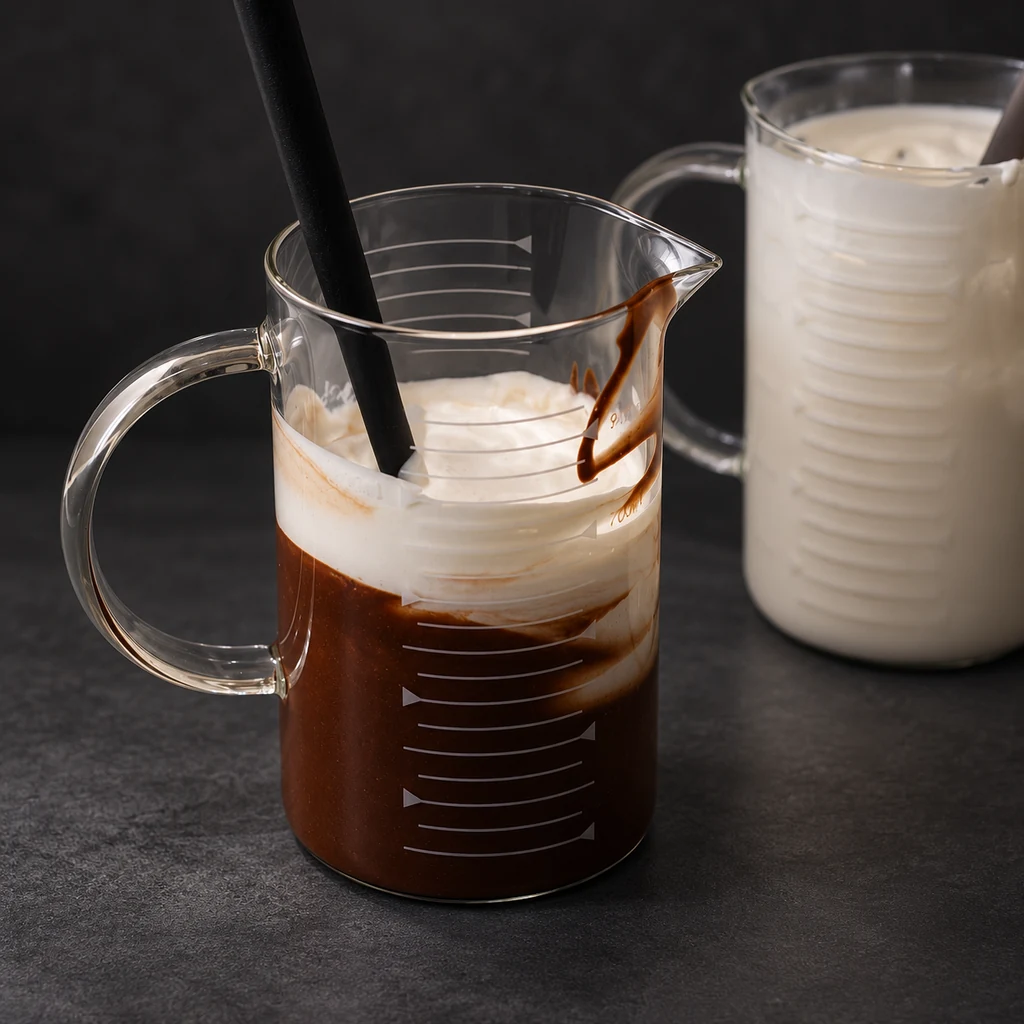
Put 100 g dark chocolate and its hydrated 6 g gelatin portion in a suitable mixing vessel. Pour over 170 g hot custard and allow the chocolate and gelatin to melt. Blend until smooth, keeping the blender head submerged to avoid unnecessary air bubbles.
Let the base cool enough that it will not melt the whipped cream, while remaining fluid. Fold in 200 g softly whipped cream gently until uniform. Pour over the sponge and keep the cake level.
Chill in the freezer for about 20 minutes, checking that the surface is set enough to support another mousse layer. The physical endpoint matters more than an exact number of minutes.
4. Add the milk and white chocolate layers
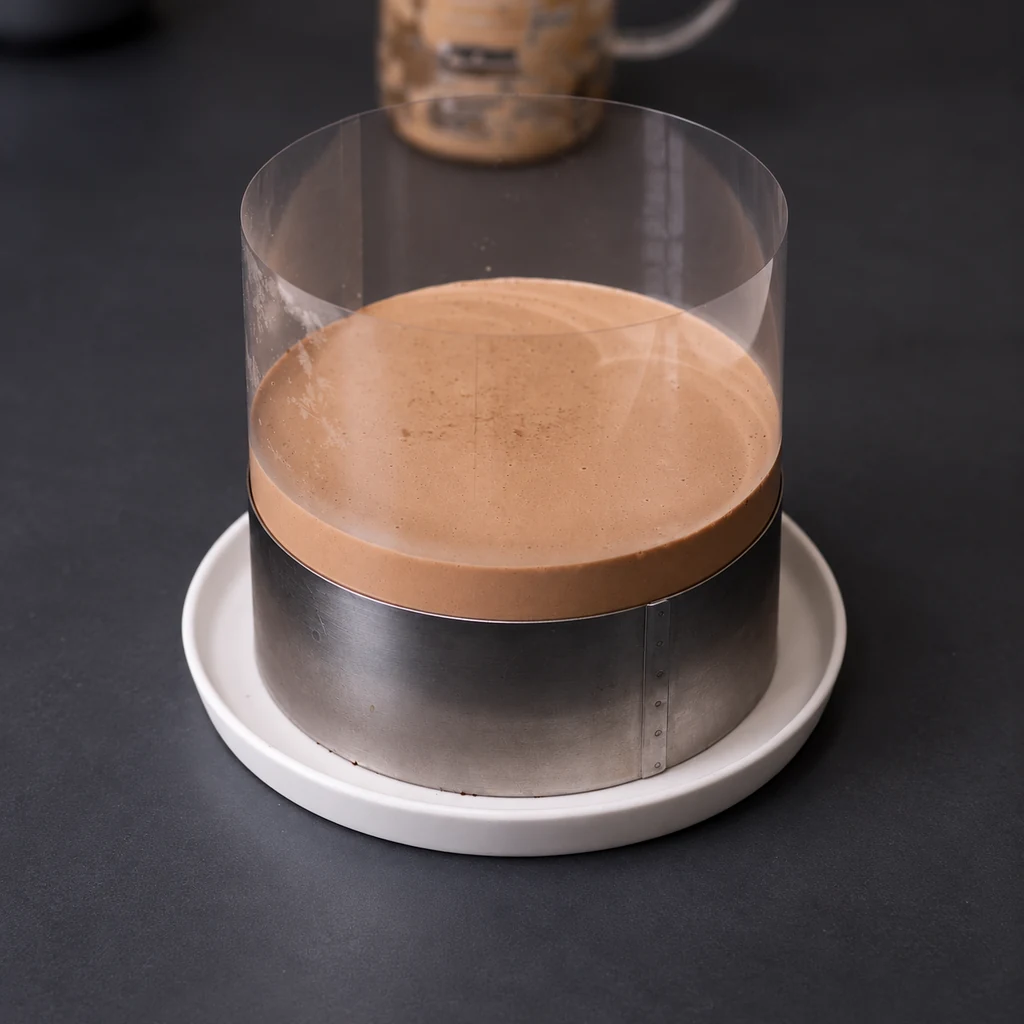
For the milk layer, combine 100 g milk chocolate, its hydrated 8 g gelatin portion and 170 g hot custard. If the custard has cooled too much to melt them, rewarm it gently and melt the hydrated gelatin separately as needed. Blend smooth, let the base cool appropriately and fold in 200 g whipped cream.
Pour the milk mousse gently over the set dark layer. Return the cake to the freezer for approximately 10–15 minutes, or until the surface can carry the final layer without mixing.
For the white layer, combine 100 g white chocolate, its hydrated 9 g gelatin portion and the remaining custard. Melt and blend smoothly as above. Once the base is suitably cool and still fluid, fold in the remaining 200 g whipped cream.
Pour onto the set milk layer, level the surface and refrigerate until the cake is fully stabilised. Do not release it simply because the upper surface feels cool; the whole mousse needs enough structure to hold a clean slice.
Check the base temperature and cream texture if a mousse turns grainy.
Keep the layer boundaries clean
A level board and a straight ring help more than repeatedly touching the surface after pouring. Let each mousse spread gently and check the cake's position before chilling.
If the previous layer is still flowing, the next mousse can mix into it. If the new mousse is too hot, it can soften what is underneath. Prepare each layer when you are ready to add it, with the earlier layer already sufficiently set.
Inverted assembly is possible with a different mould plan, but this recipe uses a single straight-sided ring from dark to white. Changing the direction, mould shape or insert diameters should be treated as a separate assembly plan.
| Problem | What to review |
|---|---|
| Colours mix at the boundary | Previous layer set and new mousse temperature |
| Grainy mousse | Cream overwhipping or base setting before folding |
| Soft slice | Gelatin hydration, product strength and final chilling |
| Uneven layer thickness | Level board, portion weights and ring dimensions |
Check hydration and the recipe balance when gelatin does not give the expected set.
Release, decorate and serve chilled
Once completely set, lift away the ring and peel off the acetate carefully. The three-colour section is already the main decoration; a smooth white top can be left simple.
Add a few clean, dry berries shortly before serving if you want a fresh accent. Keep a light hand with additional glaze or crunchy decoration so the soft mousse remains the focus.
Cut with a clean knife, wiping between slices. Keep the cake refrigerated because it contains dairy and cooked egg custard. Freezing individual layers briefly during assembly does not establish a long storage life for the finished dessert.
Common questions
How much gelatin is used altogether?
The layer amounts are 6 g, 8 g and 9 g, which total 23 g. Hydrate them separately with 24 g, 32 g and 36 g water respectively.
Can I make all three layers with one type of chocolate?
That would be a different dessert and formula. The different chocolates contribute to both flavour and firmness; do not assume the same layer balance applies after substitution.
Why did the layers mix together?
The lower layer may not have been set enough, or the new mousse may have been too warm. Check both before increasing the chilling time blindly.
Should the cream be whipped stiff?
No. Soft, supple peaks fold into the chocolate base more evenly. Stiff or grainy cream can leave lumps and lose the intended mousse texture.
Can I remove the ring after the top feels set?
Wait until the entire cake is stable, not only the surface. A fully chilled cake should hold its shape when released and sliced.