
Cakes & pastry
Caramel Ice Cream with Milk and Whipped Cream
This caramel ice cream uses a cooked milk-and-caramel base lightened with whipped cream. Split the 300 g milk and 150 g sugar in half: one portion makes a milk-powder-and-starch mixture, while the other becomes caramel milk. Cool the cooked base fully before folding it into 150 g whipped cream, then freeze.
5 min read

Caramel flavour without an egg custard
The caramel is made by browning part of the sugar before adding hot milk. Milk powder and starch give the cooked base body, while whipped cream adds fat and air.
This is an egg-free formula. It is sometimes called crème-brûlée ice cream because of its caramel flavour, but it is not a frozen version of a classic egg-yolk crème brûlée recipe.
The caramel stage determines much of the flavour. Aim for amber, not a burnt, acrid sugar mixture. Freezing and adding cream will not remove a scorched taste.
Check the caramel stage before continuing with the ice-cream base.
Caramel ice cream recipe
Set out two saucepans or suitable vessels and weigh the divided ingredients before heating. One milk portion stays cool for the starch mixture, while the other is warmed to add to caramel.
Keep the whipping cream cold until needed. The cooked caramel base must become cold too before the two are combined.
Caramel milk ice cream
One small batch; approximately 638 g before cooking losses
Ingredients
- 300 g milk, divided into 150 g and 150 g
- 150 g sugar, divided into 75 g and 75 g
- 30 g milk powder
- 150 g whipping cream, about 33% fat
- 8 g cornflour / cornstarch
Method
- Mix the dry base. Combine 75 g sugar, milk powder and cornflour. Gradually whisk in 150 g cold milk until smooth.
- Warm the other milk. Heat the remaining 150 g milk until hot, without prolonged boiling.
- Make caramel. Put the remaining 75 g sugar in a heavy-bottomed saucepan. Heat carefully until melted and amber.
- Add milk. Add the hot milk to the caramel gradually and carefully. It can bubble strongly and the caramel may temporarily harden. Stir over gentle heat until smooth.
- Cook the base. Pour in the milk-powder-and-starch mixture in a thin stream while stirring. Cook until the base thickens evenly, with no raw starch pockets.
- Strain and chill. Strain if needed, transfer to a clean container and cool promptly, then refrigerate until fully cold.
- Whip and fold. Whip the cold cream to a soft, airy texture. Add the cold caramel base in stages, folding gently to preserve the air.
- Freeze. Transfer to a freezer-suitable container and freeze until firm. If freezing without a machine, stir periodically during the early freezing stage to break up developing crystals. If using an ice-cream maker, follow its capacity and operating instructions.
The ingredients weigh about 638 g before cooking; some water evaporates as the base thickens.
Freezing time varies with container depth and freezer conditions.
Do not panic when the milk meets the caramel
Hot milk reduces the temperature shock, but the sugar can still form hard pieces temporarily. Gentle heat and steady stirring help those pieces dissolve back into the liquid.
Add the milk carefully because the mixture expands and releases steam. Use a pan with spare capacity and keep your hands away from the rising vapour.
If the caramel is burnt, start again at that stage. A bitter base becomes a bitter ice cream even when its texture is smooth.

Cool the base before adding whipped cream
A warm base can melt the structure of whipped cream and lose the air you have just created. Give the cooked mixture time to become fully cold in the refrigerator.
Whip the cream to a soft, supple texture rather than a dry, grainy stage. Add the caramel base progressively and fold until the colour is uniform.
The mixture should be even before freezing. Streaks of concentrated base or lumps of overwhipped cream do not disappear simply because the bowl is put in the freezer.
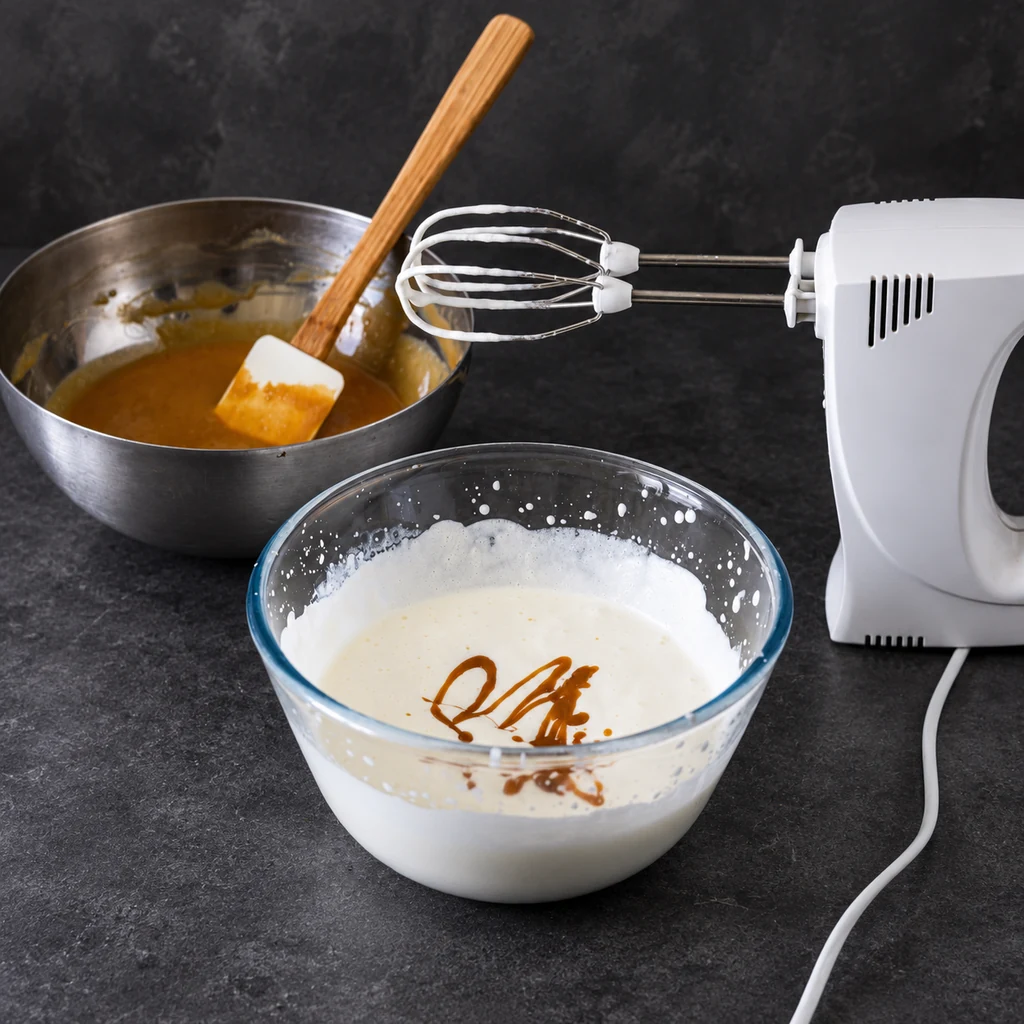
Recognise softly whipped cream before folding it into another mixture.
Freezing changes the texture as well as the temperature
A shallow container chills more evenly than a very deep one. Cover the surface and container appropriately to protect the flavour and reduce exposure to freezer air.
Without a machine, periodic stirring during the early freeze helps disrupt larger crystals. Once the ice cream is firm, repeated partial thawing and refreezing makes the texture less predictable.
Let a serving portion soften only enough to scoop comfortably. Keep the main batch frozen rather than leaving the whole container on the counter while it is served.
Why the sugar, milk powder and starch matter
Sugar provides sweetness and the caramel flavour, but it also affects how hard the ice cream freezes. Removing it without reformulating the dessert is not a neutral change.
Milk powder increases milk solids, while starch gives the cooked base viscosity. Neither guarantees a perfectly smooth result regardless of freezing method, but they are deliberate parts of this formula.
If you want a lower-sugar or dairy-free dessert, choose a complete recipe designed for that goal rather than replacing several ingredients in this one without a test.
Serve with a small contrast
A few berries, chocolate shavings or chopped nuts add contrast to the caramel. A small quantity of praline can add crunch, while baked apple gives a warmer fruit pairing.
A thin caramel topping should be cool enough for the intended presentation. A large amount of hot sauce quickly melts a small scoop.
Do not try to torch sugar directly on the ice cream to imitate a brûlée crust. If a crisp caramel element is wanted, prepare it separately and add at serving.
Common questions
Does this ice cream contain eggs?
No. The base is thickened with milk powder and starch, then combined with whipped cream.
Can I omit the sugar?
Not without reformulating. Sugar creates caramel flavour and affects freezing, so removing it changes more than sweetness.
Why did the caramel harden when milk was added?
The added liquid cools the hot sugar. Stir over gentle heat to dissolve the hardened pieces, provided the caramel is not burnt.
Do I need an ice-cream maker?
The mixture can be frozen in a container with periodic stirring during early freezing. A machine gives a different degree of agitation, so follow its instructions if using one.
Can I use the cooked base as a sauce?
The cooled base can be assessed as a separate caramel component before cream is added, but it is not the same formula or texture as a classic caramel sauce.