
Cakes & pastry
Snickers-Style Cake with Peanut Caramel and Nougat
This Snickers-style cake combines four chocolate sponge layers with peanut caramel, a frozen nougat insert and a peanut cream cheese filling. Make the sponge and nougat ahead, assemble the chilled components in a ring, then cover the stabilised cake with chocolate-butter ganache. It is a multi-stage project, so plan for overnight chilling.
8 min read
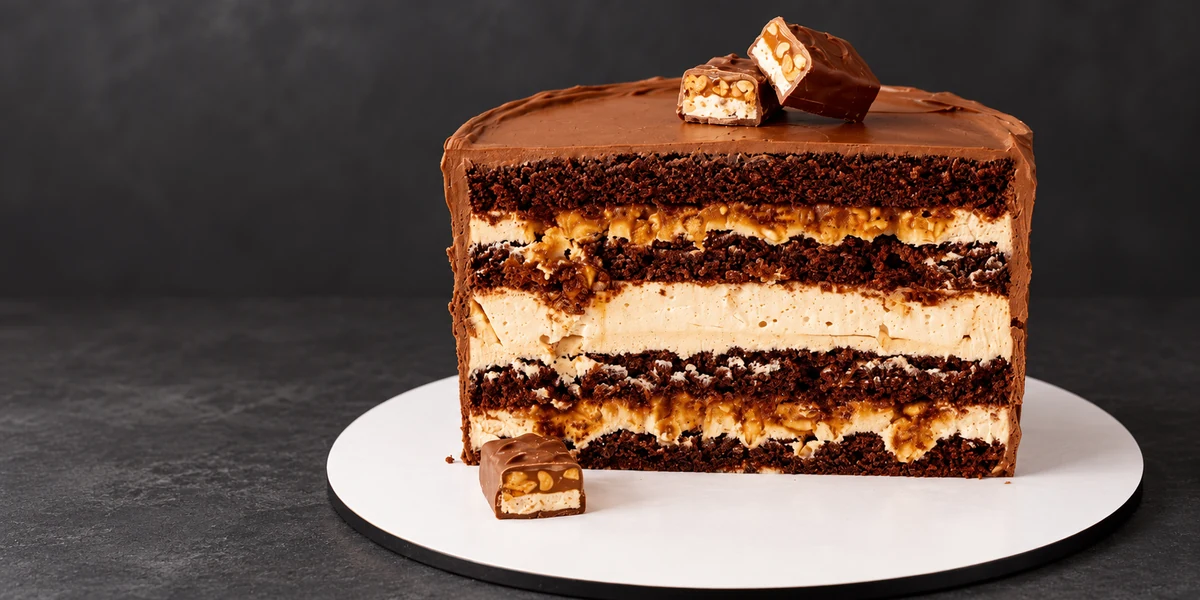
Plan the cake before you start
The flavour comes from chocolate, peanuts, caramel and a soft nougat-style insert. There are five components, but they do not all have to be made at once. Bake the sponge first and give it time to chill; make the nougat while it rests, then prepare the caramel and cream before assembly.
Use an 18 cm diameter, 10 cm high ring for the sponge and a 16 cm ring for the nougat. The smaller insert leaves space for cream around its edge. The finished cake also needs a stable board, acetate and an assembly ring.
This is a cake inspired by a familiar chocolate-bar flavour, not a recipe for the bar itself. The cream and soft insert are intended for a chilled layered dessert.
Calculate component quantities before changing the cake diameter.
1. Bake the chocolate sponge
The sponge uses a cooked cocoa mixture and a whole-egg foam. Split the sugar before you begin: 50 g goes into the cocoa mixture, while 130 g is whipped with the eggs. Cool the cocoa mixture before folding it into the foam.
Chocolate sponge for four layers
One 18 cm sponge, cut into four layers
Ingredients
- 4 eggs, consistent in size
- 180 g sugar, divided into 50 g and 130 g
- 150 g plain flour / all-purpose flour
- 5 g baking powder
- 30 g Dutch-process cocoa
- 100 g neutral vegetable oil
- 75 g water
Method
- Cook the cocoa mixture. Combine cocoa, water, oil and 50 g sugar in a heavy-bottomed saucepan. Bring to a boil, remove from the heat and let it cool a little.
- Whip the eggs. Whip the eggs with the remaining 130 g sugar until pale and voluminous. A trail from the whisk should disappear slowly.
- Finish the batter. Fold in the cooled cocoa mixture. Sift the flour with baking powder and fold it in gently until evenly combined.
- Bake. Transfer to a prepared 18 cm diameter, 10 cm high ring on a tray, with a securely sealed base. Bake in a preheated oven at 170°C (340°F) for about 50 minutes, until a skewer inserted in the centre comes out clean.
- Chill and slice. Allow the cake to cool. Remove the foil base, protect the cooled sponge with food wrap and chill for 6–8 hours. Release it from the ring and cut into four even layers, approximately 1.5 cm thick where the baked height allows.
Layer thickness depends on the actual baked height; do not sacrifice evenness to force an exact measurement.
Let the sponge cool before sealing it in wrap to avoid trapping excessive condensation.
2. Make the soft peanut nougat insert
Prepare the 16 cm ring with a tightly wrapped food-film base and set it on a firm tray before you start. The meringue becomes looser after the gelatin is added, so the base must be secure before the mixture is poured.
The water is divided: 30 g hydrates the gelatin and 45 g goes into the sugar syrup. Use a thermometer for the syrup. Hot syrup should run into the moving egg-white mixture in a controlled stream without splashing against the whisk.
Peanut nougat-style insert
One 16 cm insert
Ingredients
- 45 g egg white, preferably pasteurised and suitable for whipping
- 100 g sugar
- 30 g glucose syrup
- 50 g peanut paste
- 6 g powdered gelatin, 220 Bloom
- 75 g water: 30 g for gelatin and 45 g for syrup
- 20–30 g, optional chopped peanuts
Method
- Hydrate the gelatin. Mix the gelatin with 30 g cold water and let it fully swell according to its instructions.
- Start the meringue. Add a couple of tablespoons taken from the measured 100 g sugar to the egg white. Whip gradually to a substantial foam, with no loose liquid remaining.
- Cook the syrup. Combine the remaining sugar, 45 g water and glucose syrup. Heat in a heavy-bottomed saucepan to 120°C (248°F). Pour it in a thin stream into the whites while whisking, then continue to a thick, stable mixture.
- Add gelatin and peanut paste. Melt the hydrated gelatin gently and mix it into the meringue. Add the peanut paste and mix until even. Fold in the optional chopped peanuts if using.
- Freeze the insert. Pour into the prepared 16 cm ring and level. Freeze for at least 1 hour, and until firm enough to release and transfer cleanly.
Use pasteurised egg white suitable for whipping.
The optional extra peanuts are separate from the 100 g used in the caramel filling.
3. Prepare the peanut caramel
The caramel recipe makes more sauce than the 130 g initially mixed with the peanuts. Weigh that portion after cooling. Keep the remainder separate instead of automatically putting all the sauce into the filling.
Caramel and peanut filling
One batch for two filling layers, with some caramel left over
Ingredients
- 120 g sugar
- 150 g whipping cream, about 33% fat
- 100 g roasted salted peanuts, roughly chopped
Method
- Melt the sugar. Heat the sugar in a heavy-bottomed saucepan over controlled heat until amber. Gently tilt the pan for even melting and avoid scorching.
- Add hot cream carefully. Heat the cream separately until just reaching a boil. Add it gradually to the caramel while stirring, taking care because the mixture bubbles strongly. Cook for 1–2 minutes.
- Strain and cool. Strain the caramel through a suitable heatproof sieve if needed to remove hard lumps. Let it cool before combining it with the nuts.
- Mix the filling. Combine 130 g of the cooled caramel with the roughly chopped peanuts. Divide the filling into two equal portions for assembly.
Do not taste hot caramel. Allow a sample to cool before checking flavour or texture.
Reserve surplus caramel separately; it is not included automatically in the two filling layers.
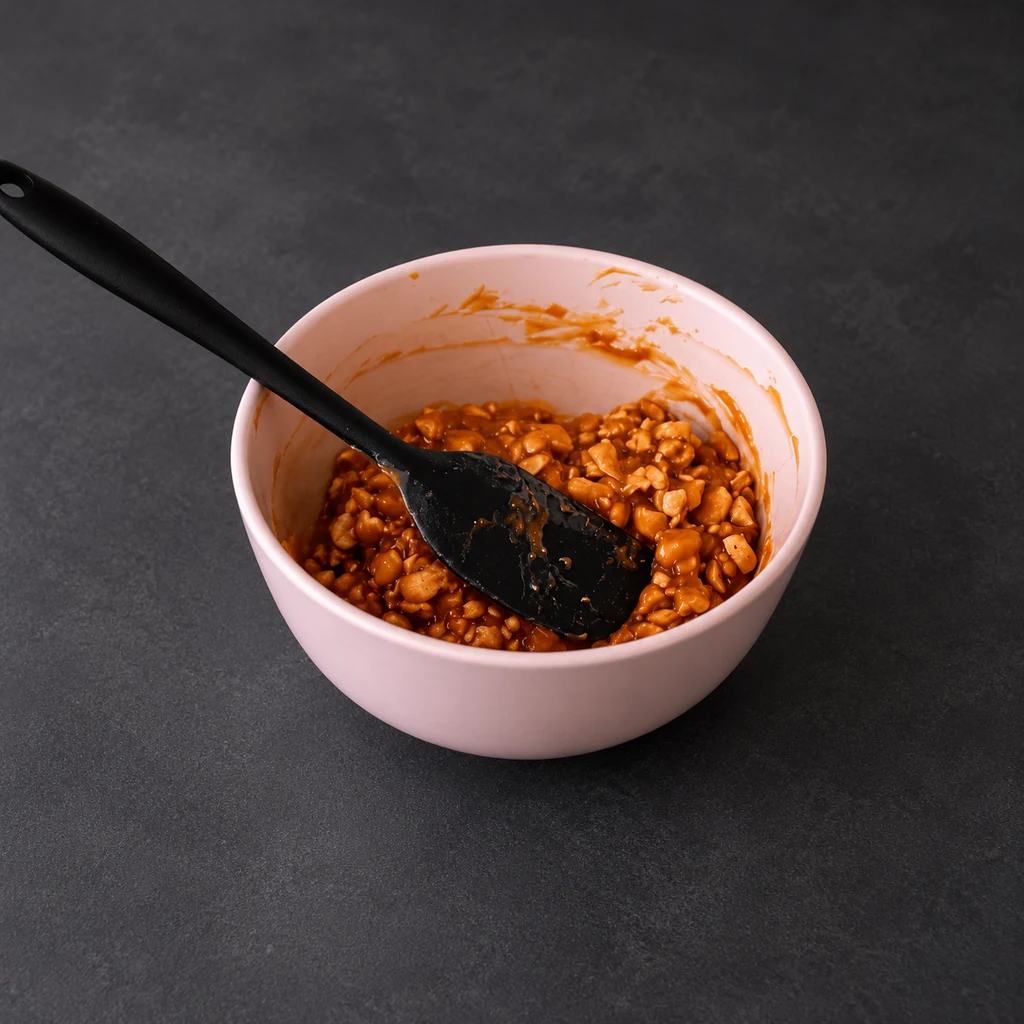
Check graininess, bitterness or separation before adding the peanuts.
4. Whip the peanut cream cheese filling
Use cold cream cheese and cold whipping cream. Mix the cheese, cooked condensed milk and peanut paste first so the cream does not have to be whipped longer simply to remove lumps.
Peanut cream cheese filling
Enough for the three filling gaps
Ingredients
- 400 g full-fat cream cheese
- 150 g whipping cream, about 33% fat
- 100 g cooked sweetened condensed milk / dulce de leche
- 90 g peanut paste
Method
- Mix the base. Beat the cream cheese, cooked condensed milk and peanut paste until uniform.
- Whip. Add the cold cream and whip until the filling is thick enough to hold its shape. Stop once it is ready rather than continuing until grainy.
- Divide. Divide the filling into three equal portions by weight. The middle portion will be split again to go below and above the nougat insert.
Peanut paste products vary in sweetness and texture. Use a consistent product and note whether it contains added sugar or oil.
Recognise the texture of a cream cheese filling before assembly.
5. Assemble from the bottom up
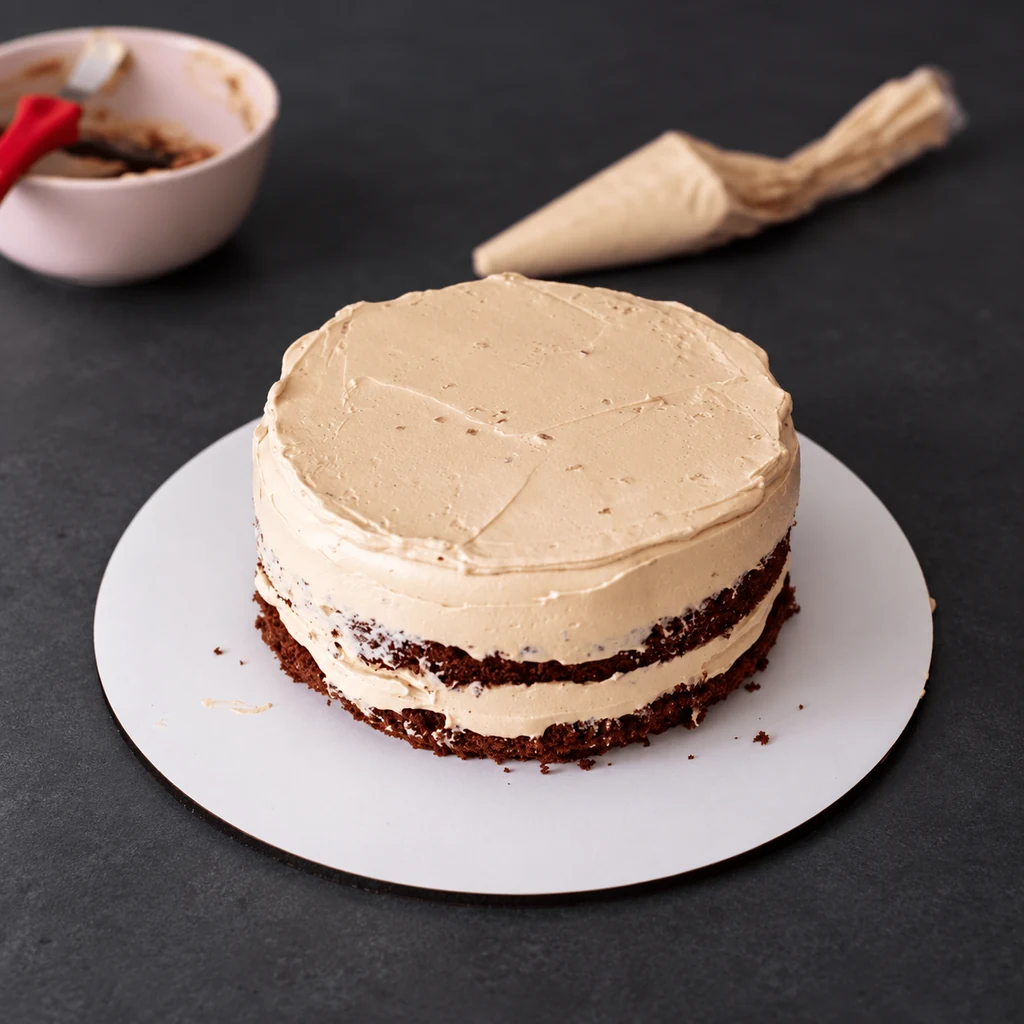
Secure the first sponge layer to the board with a small dab of filling. Use the first third of the cream to cover it and form a border around the edge. Spread half of the peanut caramel within that border, then add the second sponge.
Spread half of the second cream portion over the second sponge. Release the firm nougat insert from its ring, remove all film and place it centrally. Use the other half of that cream portion around and over the insert.
Add the third sponge. Use the final third of the cream and the remaining peanut caramel as for the first filling layer, then place the fourth sponge on top. Using the flat bottom of the original sponge as the upper face can make the finish easier.
Wrap the sides in acetate and secure the cake in a ring. Refrigerate for several hours, preferably overnight, until the layers are stable enough to finish. Keep the cake level during chilling.
6. Finish with chocolate-butter ganache
This finishing cream uses chocolate and butter without cream. Let the melted chocolate cool to about 30°C (86°F) before adding soft butter. If it is too warm, the butter melts and the mixture stays loose.
Chocolate-butter finishing cream
One batch for coating the cake
Ingredients
- 150 g milk chocolate
- 150 g dark chocolate
- 150 g butter, about 82.5% fat, softened
Method
- Melt and cool. Melt the chocolates gently together and let them cool to approximately 30°C (86°F). Stir to keep the temperature even.
- Whip with butter. Add the softened butter and beat to a thick, stable texture. If too loose, allow it to cool slightly, checking frequently, then mix again.
- Coat. Remove the chilled cake's ring and acetate. Apply the finishing cream and smooth the sides and top. Keep the cake refrigerated until serving.
A coating consistency is not automatically a drip consistency. Test a small amount before adding decorative drips.
Identify a separated chocolate mixture before trying to coat the cake.
Keep the decoration focused on the filling
Roasted peanuts, a little chopped chocolate or a few pieces of a compatible chocolate bar can echo the filling. Add them deliberately rather than hiding the whole top under a heavy mound.
Use a clean knife and wipe it between slices to show the four sponge layers and central nougat. Serve the cake chilled enough to hold its shape. It contains dairy, eggs and peanuts, so keep the assembled cake refrigerated and communicate the ingredients to anyone you serve.
If a component is not firm enough at assembly time, give it the time it needs. Rushing a warm caramel or a loose nougat into the cake creates problems that a thick outer coating will not fix.
Common questions
Can I make this cake in one afternoon?
The active work can be split across an afternoon, but the sponge needs 6–8 hours of chilling and the assembled cake benefits from an overnight rest. Plan ahead rather than treating it as a quick bake.
Why is the nougat ring smaller than the sponge?
The 16 cm insert fits inside the 18 cm cake, leaving space for cream around its edge.
Do I put all the caramel into the peanuts?
Start with the specified 130 g of cooled caramel for 100 g peanuts. The caramel recipe makes some extra sauce; adding all of it can make the filling too loose.
Can I skip the nougat?
You can choose a different cake design, but omitting it changes the intended central layer and the filling distribution. The recipe here includes the complete nougat component.
Why is my chocolate-butter coating runny?
Check the temperature first. Chocolate that is too warm melts the butter. Let the mixture cool gradually and reassess before adding extra ingredients.